
Rating
Know your rating.
Play the right match.
One number from 1.0 to 7.0 that tells you — and everyone you are about to play with — what kind of game to expect. Calculated from how you actually play, confirmed by coaches.
Better matches
A game where everyone is close in rating is the one worth driving to.
Honest filters
Games, tournaments and training can set a rating range that actually means something.
Visible progress
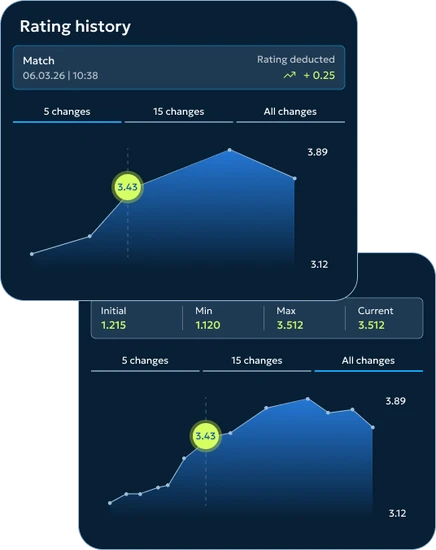
Improvement stops being a feeling and becomes a number you can watch move.
Travels with you
The same rating applies at another club, in another city, with people you have never met.
The scale
From first lesson to Premier Padel.
Nine bands across the scale. Find the description that sounds like your last match — that is roughly where you are.
Absolute beginner
First steps on court. You are learning the rules and the basic positions, and strokes happen on instinct — around 70% of them miss. The glass catches you out, the score gets confusing, and movement around the court is more improvised than planned.
Beginner
The rules make sense and the grip is coming together. About half of your strokes reach the target, but coordination is still uneven, direction is hard to control, and the net is somewhere you approach reluctantly.
Developing player
Basic strokes and a simple serve, landing around 40% of the time. You are starting to move to the net, but returning serve is a struggle, the backhand gets avoided, positioning goes wrong, and tactics are not yet part of the game.
Recreational player
You control about 60% of your strokes, the lob has become reliable, and you play actively at the net. The score is no longer a mystery. What is missing is variety — the range of strokes is limited and depth suffers.
Average recreational player
Consistent from the baseline, varied serves, and a growing set of strokes at around 70% control. The next steps are tactical: reading the point, working the net, and the overhead game.
Experienced amateur
Technical strokes with control over depth and pace, confident at the net, and the bandeja is part of your game. You understand doubles tactics — what needs work is the counterattack and holding up in the long, awkward rallies.
Advanced player
Confident control of depth, direction and spin, with the full attacking set — bandeja, víbora, rulo. You read the opponents' game and move in sync with your partner. Errors sit around 30%, and stability under pressure is the remaining gap.
Semi-pro
Refined technique, fast reactions, control of pace and the psychological side of a match. You compete in top local tournaments with errors around 20% — the weak point tends to be closing out tight endings.
Professional
Flawless technique, immediate reactions and a full tactical arsenal. You play FIP and Premier Padel events, read an opponent's game instantly, and keep errors below 10% — controlling everything from the psychology of a match to its tempo.
How it is set
Two inputs. One number.
Results tell you who wins. They do not tell you whether someone can hit a bandeja. So the rating has two sources, and neither works alone.
Calculated
Your match and tournament results move the number automatically, based on how you actually play and against whom.
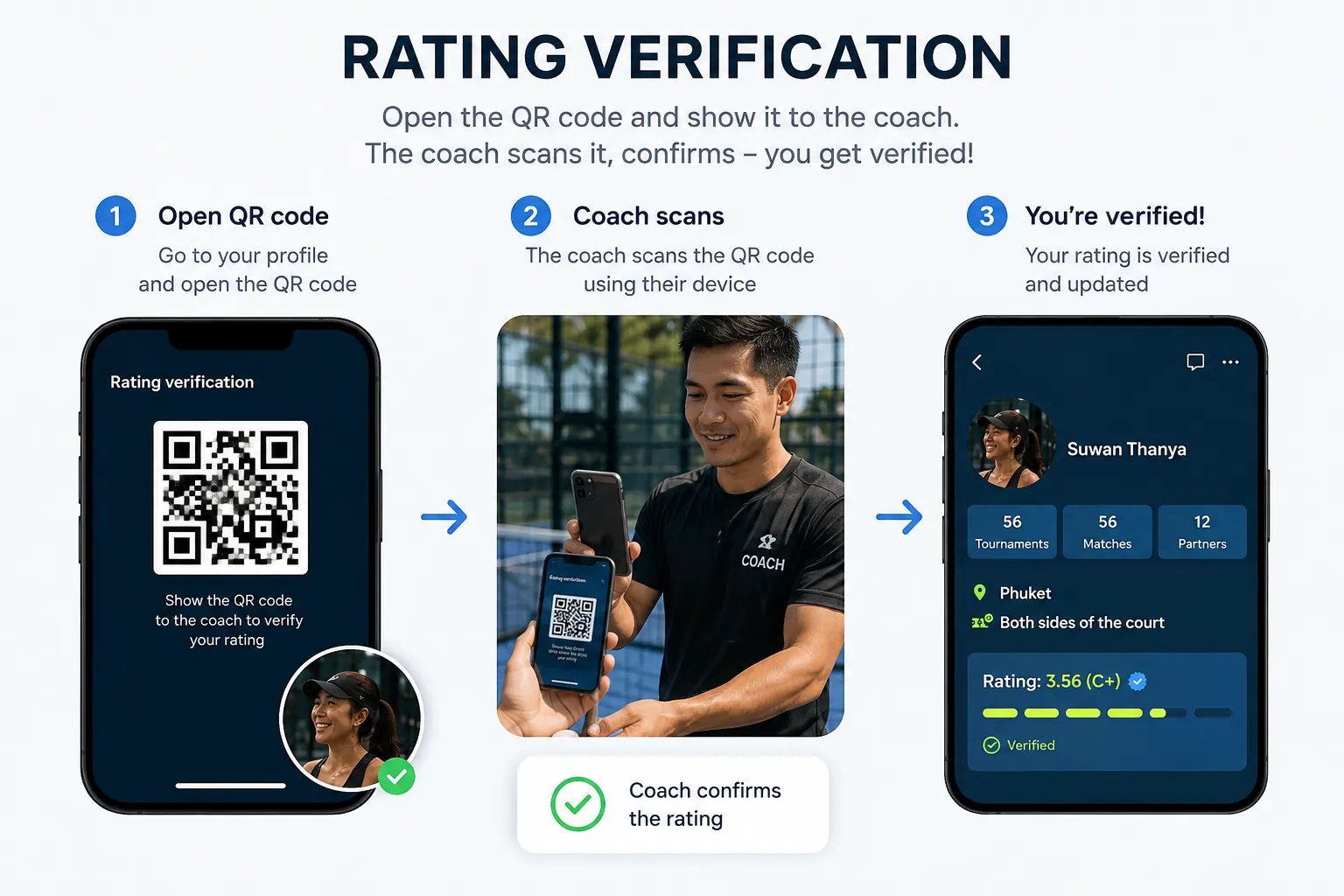
Verified
Approved coaches confirm or adjust the rating of players they have worked with, using criteria that are the same for everyone.
New to the app? Your starting rating comes from a coach assessment or from your first results.
Two inputs meeting at one value on a 1.0–7.0 axis: match results feeding the automatic calculation from one side, coach verification from the other. Calm and factual — this is the most questioned mechanic in the product.
MOTION — the axis draws once, the calculated value lands first, then the coach mark snaps it into place. Two beats, in that order, so the roles are unmistakable.
Two players between points, one showing the other something on a phone. Ordinary, unposed — the rating is a thing people talk about, not a badge they display.
For players
How to move your number.
Play, and the calculation follows you. Train, and a coach can confirm what the results have not caught up with yet.
- Play rated games and tournaments — results feed the calculation
- Play people around your own rating; lopsided matches teach the system less
- Train with an approved coach, who can verify your rating directly
- Watch the history rather than the daily number — a rating is a trend
For coaches
Verification is a responsibility.
A verified rating affects every game that player joins for months afterwards. That is why the right to assign it is granted rather than switched on, and why the criteria are the same for everyone who holds it.
What you assess
Consistency
How often the ball lands in court when the player performs a given element.
Tactics
Whether the positions are right for the situation — moving to the net after the serve, and so on.
Technique
Timing of the swing, the contact point, and the other mechanics behind the stroke.
Getting verification rights
Tell us who you are and where you coach. Name, email, phone and a short comment are enough to start the review.
Where to send it
Use the form above. A name, email and phone number is enough to start the review — the comment is optional context for the assessor.
Rating examples on video
Each band on the scale links to a clip showing real play at that rating. Go to the scale
Source: coach verification instructions supplied by the client. Two adaptations made deliberately — personal contacts replaced with a placeholder route, and the regional social network link left unresolved pending a decision on the international audience. Both need a decision before this section publishes. All nine rating bands are embedded from the YouTube playlist.
FAQ
Rating questions.
Who decides my rating?
Both the system and a person. Your results move the number automatically, and an approved coach can confirm or adjust it after working with you.
What is my rating when I start?
It comes either from a coach assessment or from your first recorded results.
Can my rating go down?
Yes. It reflects how you are playing now, not the best week you ever had.
Does my rating work at other clubs and in other cities?
Yes — the same number applies wherever the ecosystem is live, which is the point of having one.